

I used to think the interesting question was: did Google's AI promises move the stock?
That is still a real question, but it is too small. In 2026, the better question is: what is Google's actual AI pattern, and which parts of it compound?
Google's AI history is not a clean heroic arc. It is not "Google invented everything and therefore wins." It is also not "Google missed ChatGPT and therefore is doomed." Both takes are lazy. The more useful version is messier and more practical: Google tends to create or absorb important research early, slowly wire it into infrastructure, hide it inside giant products, stumble when the interface becomes public and conversational, then recover when the work becomes a system instead of a demo.
That pattern matters for builders because it shows how research turns into product gravity. It matters for investors because Alphabet's value is not a referendum on one model launch. And it matters for anyone trying to understand AI because Google is one of the few companies where all four layers are visible at once: frontier research, consumer distribution, custom compute, and an advertising business that is both threatened and strengthened by AI.
This is the 2026-aware version of the story.
The Short Version
Google's AI advantage is not a single chatbot. It is a loop:
- Research creates techniques and models.
- Infrastructure makes those models cheap enough to run at absurd scale.
- Products expose the models to billions of users.
- Usage data, enterprise demand, and market pressure fund the next infrastructure cycle.
The loop is powerful. It is also fragile. If Search answers too much and sends too little traffic to the web, publishers get angry. If Gemini gets a sensitive image prompt wrong, the mistake becomes a public trust story. If AI answers are too expensive, the margin story gets worse. If the models lag, the whole full-stack narrative starts to sound like a spreadsheet explaining away a product gap.
So the right stance is neither worship nor dismissal. Google AI is a compounding machine with very public failure modes.
A Concise Timeline
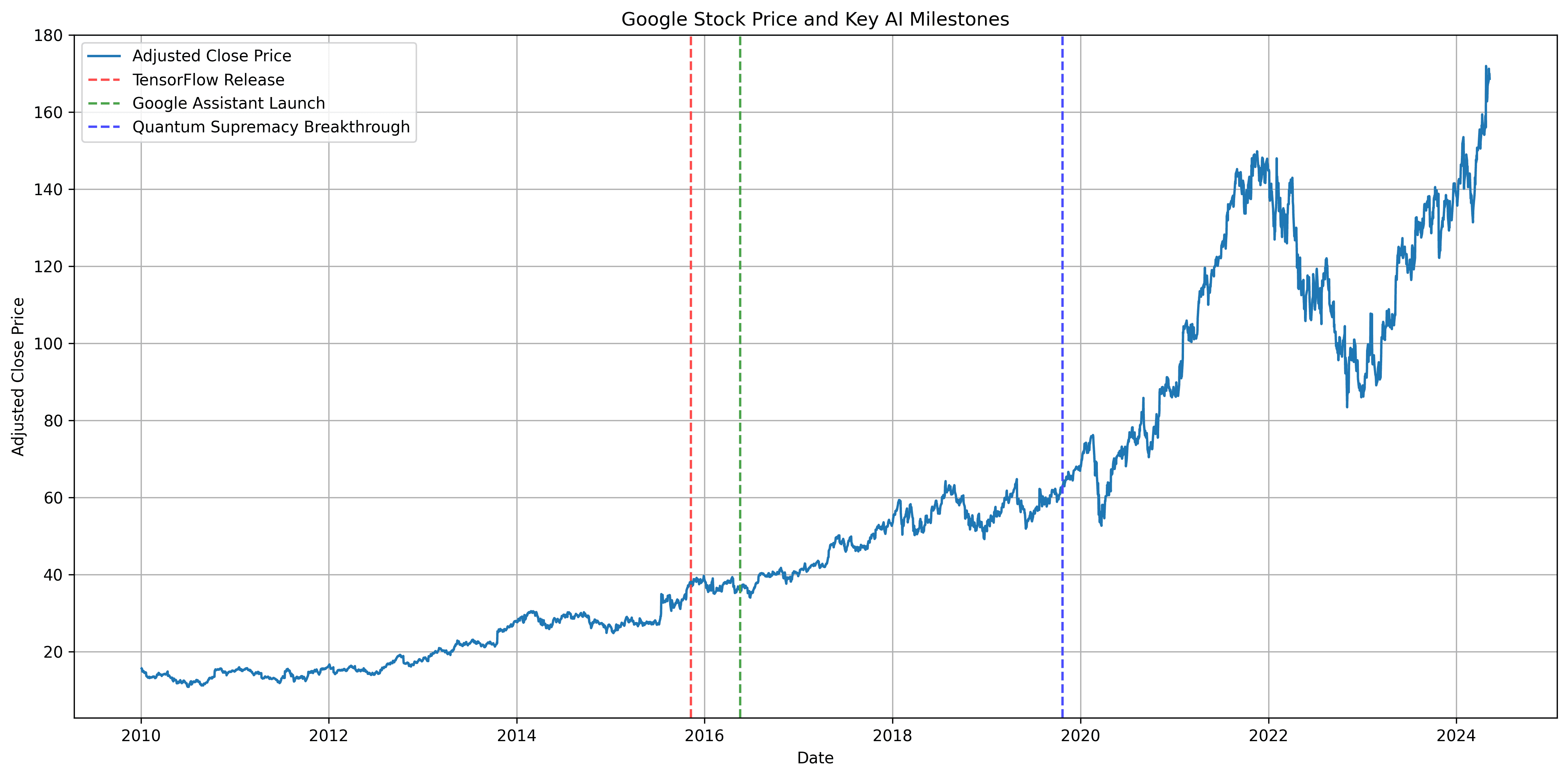
- 2011-2015: internal scale before public AI branding. Google's DistBelief infrastructure helped train large neural networks internally. In November 2015, Google open-sourced TensorFlow, making part of that internal machine learning stack available to the wider world.
- 2016: AlphaGo and "AI-first." DeepMind's AlphaGo made AI feel less like a lab curiosity and more like a new kind of problem-solving engine. Google also began talking about itself as an AI-first company rather than a mobile-first company.
- 2017: the Transformer. The paper Attention Is All You Need, from Google researchers, introduced the Transformer architecture that now sits under much of modern generative AI.
- 2019: BERT enters Search. Google applied BERT models to Search ranking and featured snippets, using machine learning to better understand language and query intent.
- 2020-2024: science becomes a proof point. AlphaFold showed that AI could produce scientific utility, not just impressive demos. By 2025, Google DeepMind described AlphaFold as a five-year scientific impact story recognized with a Nobel Prize.
- 2023: Google DeepMind is formed. Google merged DeepMind and the Brain team into Google DeepMind, putting more of its model work under one focused research organization.
- December 2023: Gemini begins. Google introduced Gemini 1.0 as the first model family of the Google DeepMind era.
- 2024: AI leaves the lab and breaks in public. Gemini image generation was paused after inaccurate people images, and AI Overviews launched in Search before producing a round of strange, high-profile answers. This was not just PR noise. It exposed the difficulty of putting probabilistic systems into trusted surfaces.
- 2025: inference becomes infrastructure strategy. Google announced Ironwood, its seventh-generation TPU, as a chip designed for the age of inference.
- 2026: the agentic Gemini era. At I/O 2026, Google framed the next chapter around Gemini, Search agents, AI Mode, developer agents, and a full-stack AI approach. As of June 2026, that is the live strategic frame.
That timeline is not a straight line from invention to dominance. It is a line from invention to distribution, with several potholes in the middle.
What Aged Well
The first thing that aged well is the boring claim: Google's AI history really is deep.
It is fashionable to reduce AI leadership to who has the best consumer chatbot this month. That misses how much of the current era was pre-built by long-running work: TensorFlow, TPUs, BERT, Transformers, AlphaGo, AlphaFold, seq2seq models, and the habit of serving machine learning inside products with billions of users. Google's 2023 DeepMind merger announcement explicitly listed many of these as the shared inheritance of DeepMind and Brain.
The second thing that aged well is infrastructure.
In 2024, it was easy to talk about AI as if the model was the product. By 2026, the compute layer is impossible to ignore. Google's Ironwood TPU announcement described a shift from training-centric AI to inference at scale. Google Cloud later framed Ironwood as part of a long custom-silicon line that includes TPUs, YouTube video chips, and Tensor mobile chips.
That matters because the future of AI is not only "who can train the smartest model?" It is also "who can afford to answer the next billion questions?" Search, Gemini, Workspace, Android, YouTube, Cloud, and agents all become more convincing if Google can reduce the cost and latency of intelligence.
The third thing that aged well is distribution.
Google can put AI into Search, Gmail, Docs, Maps, Android, Chrome, Pixel, YouTube, Photos, and Cloud. That does not guarantee good product taste. It does mean that once a feature works, distribution is not the hard part. At I/O 2026, Google said AI Overviews had more than 2.5 billion monthly active users and AI Mode had passed 1 billion monthly users in its first year. Even allowing for the self-promotional nature of keynote metrics, the scale is the point. A mediocre feature at Google scale can teach you more than a beautiful demo with no users.
The fourth thing that aged well is the idea that Google AI is bigger than search ads.
Waymo is not Gemini. AlphaFold is not Search. TPU customers are not YouTube viewers. But they all sit under the same Alphabet logic: patient technical bets that are allowed to look strange for years before they either become product infrastructure or remain expensive optionality. In Q1 2026, Alphabet said Waymo surpassed 500,000 fully autonomous rides per week. That is still not the core business. But it is no longer a science fair prop either.
What Did Not Age Well
The old stock-first framing did not age well.
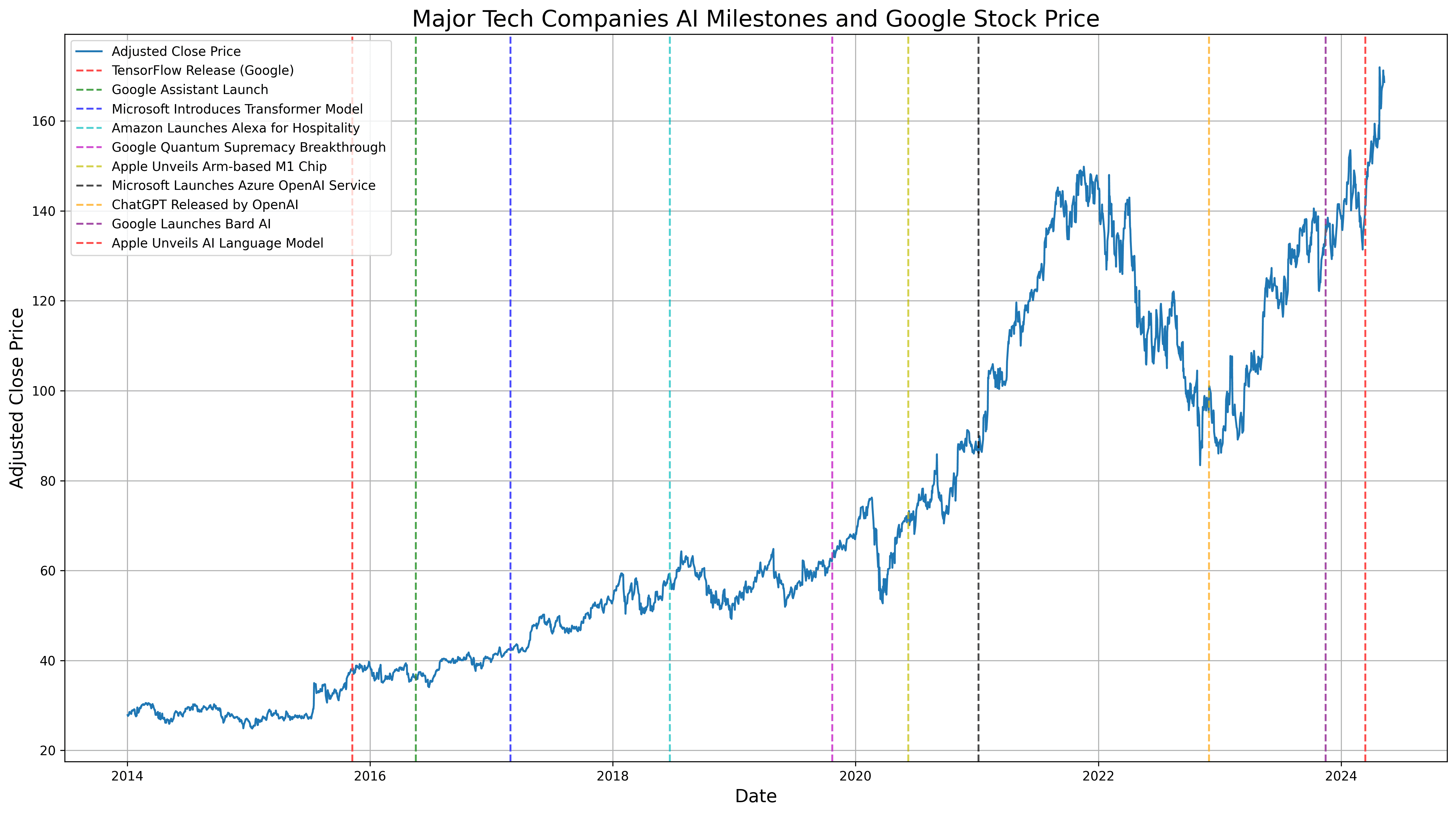
Stock reactions are real, but they are noisy thermometers. Alphabet's 2023 Bard demo error reportedly helped wipe about $100 billion in market value in a day. That was embarrassing and meaningful. It also did not decide Google's AI future. A public demo can move sentiment faster than it moves product reality.
The same works in reverse. A strong earnings print does not prove that every AI bet is good. It proves that investors were willing, at that moment, to believe the spend had a path to returns. That distinction matters.
The second thing that did not age well is the idea that Google could simply "ship harder."
Google's problem was never a lack of models. It was the collision between AI uncertainty and Google-scale trust. When Gemini image generation produced inaccurate or offensive people images, Google paused the feature and explained that its tuning had overcorrected in some contexts. When AI Overviews produced odd answers in 2024, Google explained that Search AI is tied to ranking systems and web results, but also admitted that misinterpreted queries, thin source material, and forum sarcasm could still break the experience.
Those incidents are not footnotes. They are the product lesson. AI at Google is not just about capability. It is about capability under brand pressure, regulatory pressure, publisher pressure, and user trust pressure.
The third thing that did not age well is the assumption that open research goodwill would automatically carry forward.
TensorFlow was a huge open-source moment in 2015. The modern Gemini era is more mixed: closed frontier models, open Gemma models, API access, Cloud services, and tightly managed consumer surfaces. That may be commercially rational. It also means Google's relationship with builders is more transactional than it was in the TensorFlow moment. Developers do not only ask "is the model smart?" They ask whether the platform is stable, affordable, portable, and boring enough to build on.
The Google AI Pattern
Here is the mental model I find most useful now:
Research is the seed. Google is very good at producing research that becomes foundational later. The Transformer is the obvious example. AlphaFold is the better reminder that the same research culture can matter outside consumer software.
Infrastructure is the moat attempt. TPUs, data centers, networking, cooling, and software stacks are not glamorous, but they decide whether AI can be served profitably. In Q1 2026, Alphabet's purchases of property and equipment were $35.7 billion. That is not just "AI vibes"; it is hard capital moving into servers, network equipment, and data centers.
Products are the proving ground. Search is the dangerous one because it prints money. Cloud is the cleanest business story because customers pay for compute, models, and enterprise AI tooling directly. Android and Workspace are distribution layers. Gemini is both a product and a brand wrapper around the model family.
Market perception is the pressure gauge. Investors do not evaluate Google AI like researchers do. They ask a smaller set of questions: will AI grow Search usage or cannibalize ad clicks? Will Cloud take share? Will capex produce revenue, margin, or strategic control? Will Google avoid regulatory and reputational mistakes?
When you see Google announce a new model, do not ask only whether it beats a benchmark. Ask where it enters the loop.
Does it make Search more useful without wrecking the web ecosystem? Does it make Cloud easier to sell? Does it lower cost per answer? Does it improve Android or Workspace enough that users notice? Does it make developers build on Google rather than merely test the demo and leave?
That is the pattern.
Gemini Is a Strategy, Not Just a Model
Gemini began as a model family, but by 2026 it is more like Google's AI operating label.
There is Gemini in the app. Gemini in Search. Gemini in Workspace. Gemini in Cloud. Gemini in Android. Gemini in developer tools. Gemini as a consumer subscription driver. Gemini as API traffic. Gemini as an agentic story.
This can be confusing because "Gemini" does too much semantic work. It can mean the frontier model, the app, the API, the assistant, the branding layer, or the enterprise story. But the sprawl is also the strategy. Google wants Gemini to be the connective tissue across surfaces that used to feel separate.
That is why the 2026 I/O language matters. Google was not just saying "our model is smarter." It was saying AI is moving from assistance into agents, from isolated prompts into workflows, and from chatbot novelty into product surfaces people already use.
I am cautious about the word "agentic" because it is becoming the new "blockchain": sometimes meaningful, sometimes sprayed onto slides. But in Google's case the direction is clear enough. Search agents, AI Mode, Antigravity, Gemini API managed agents, Workspace context, and Android tooling are all attempts to turn models into systems that take action.
The test is not whether a keynote demo looks alive. The test is whether users trust the agent with boring, repeated, consequential work.
The Careful Stock-Market Angle
Alphabet stock is not a pure AI stock. It is an advertising, cloud, subscription, infrastructure, and optionality stock with a giant AI question sitting inside it.
That makes the market angle more subtle than "AI announcement equals stock up."
The Bard mistake in February 2023 showed how quickly sentiment can punish Google when investors believe it is losing the narrative to Microsoft and OpenAI. But the 2026 earnings story shows the opposite pressure: if Search revenue grows, Cloud accelerates, Gemini subscriptions rise, and infrastructure demand looks real, investors can become more patient with heavy AI spending.
Alphabet's Q1 2026 numbers are useful because they show why the market was willing to listen. Revenue was $109.9 billion for the quarter. Google Cloud revenue was just over $20 billion, up 63% year over year, with operating income of $6.6 billion. Google said Cloud backlog nearly doubled quarter over quarter to more than $460 billion. Search and Other advertising grew 19%. Those numbers do not prove Google will win AI, but they make the bear case work harder.
The cleanest way to read the stock-market angle is this:
- Short term: demos, mistakes, lawsuits, product launches, and earnings language move sentiment.
- Medium term: Search usage, AI ad formats, Gemini subscriptions, Cloud backlog, TPU demand, and capex discipline matter more.
- Long term: the question is whether Google can turn AI from a cost shock into a margin-preserving product layer.
That last point is the whole game. If AI makes every search more expensive while reducing publisher goodwill and ad clicks, the market will eventually care. If AI makes Search more useful, Cloud more differentiated, Workspace stickier, and compute more efficient, the market will forgive a lot.
What Builders Should Learn From Google AI
The builder lesson is not "be Google." You are not going to have Search, YouTube, DeepMind, TPUs, Cloud, Android, and a data-center budget in your side project. Charming, but no.
The useful lesson is about sequencing.
First, research is not product. A model capability becomes valuable only when it is placed into a workflow where the user already has intent. Search is powerful because the user arrives with intent. Workspace is powerful because the user arrives with work. Cloud is powerful because the customer arrives with a budget and a deployment problem.
Second, evals are not enough. Google's public failures were often not "the model is dumb" failures. They were context failures, policy failures, retrieval failures, product-surface failures, and expectation failures. If your AI feature touches trust, money, health, identity, current events, or public reputation, your eval suite needs to include the world around the model.
Third, cost is product design. A feature that is magical at $1 per answer and tolerable at $0.01 per answer is not the same feature. Google's obsession with TPUs, latency, and cost per response is not merely a finance story. It shapes what product experiences are possible.
Fourth, distribution can hide weakness for a while, but it cannot hide bad utility forever. Google can put Gemini in front of hundreds of millions of people. That gives it time and feedback. But users still notice when something is slow, wrong, annoying, or not worth changing habits for.
What I Would Watch Next
I would watch five things.
Search behavior. AI Overviews and AI Mode are the center of the Google AI story because Search is the business heart. Watch whether people search more, whether commercial queries remain monetizable, and whether publishers keep supplying the web that AI Overviews depend on.
Cost per useful answer. The quiet sentence in any AI earnings story is about cost. If Google keeps reducing inference cost while model quality improves, its distribution advantage gets sharper.
Cloud conversion. Backlog is promising. Revenue and operating income are better. Customer retention and actual AI workloads are better still. Google Cloud is where the AI story becomes most directly sellable.
Agent reliability. Agents are easy to demo and hard to trust. I care less about whether an agent books one restaurant in a keynote and more about whether it handles messy real-world constraints without creating cleanup work.
Failure response. Google will make more AI mistakes. Everyone will. The real signal is how quickly the company narrows the blast radius, explains the issue, improves the system, and resists pretending the problem was only user misunderstanding.
The Useful Conclusion
Google's AI story is not a comeback story. It is not a fall-from-grace story either. It is a long compounding story with a very awkward public middle.
What aged well: the research depth, the infrastructure bet, the distribution advantage, and the idea that AI would eventually touch every major Google surface.
What did not age well: treating stock moves as proof, treating model launches as destiny, and underestimating how hard it is to put generative AI into products people expect to trust.
The practical mental model is simple:
Google wins when research, infrastructure, product, and monetization reinforce each other. Google stumbles when one layer outruns the others.
That is why the stock-market angle should be secondary. The stock is only the shadow on the wall. The real object is the loop.
Sources and Further Reading
- TensorFlow open-sourced by Google Research
- Attention Is All You Need
- Google Search and BERT
- Google DeepMind merger announcement
- Introducing Gemini 1.0
- AI Overviews launch in Search
- Google's AI Overviews post-launch explanation
- Gemini image generation issue explanation
- I/O 2026: agentic Gemini era
- Google Search I/O 2026 updates
- Google I/O 2026 developer keynote recap
- Alphabet Q1 2026 CEO remarks
- Alphabet Q1 2026 results filed with the SEC
- Ironwood TPU announcement
- Ironwood TPU general availability and AI Hypercomputer notes
- AlphaFold five-year impact note
- AlphaGo at 10
- Reuters note on the 2023 Bard market reaction
Comments